
Market News · Holiday Sourcing
Halloween and Christmas 2026 Sourcing Outlook: Packaging and Seasonal Supplies
A current-affairs review for overseas buyers sourcing holiday drawstring bags, lanterns, flags, artificial flowers, and export packaging in a value-conscious and compliance-focused market.
Published by Tokicraft

Market position on August 24, 2026: overseas buyers are entering the final Halloween execution window while Christmas specifications, samples, and shipping plans need to be fixed. Demand has not disappeared, but the winning offer is moving away from novelty alone and toward value, delivery control, reusable presentation, and clearer compliance records.
What the latest retail data actually says
The National Retail Federation forecasts total U.S. retail sales to rise 4.4% in 2026 to $5.6 trillion. That indicates continued consumer resilience, but it is not a Halloween or Christmas-specific forecast. NRF says its Halloween survey is normally released in late September, so no responsible August article should present a 2026 Halloween spending number as settled.
The latest available Halloween benchmark is 2025: NRF expected record spending of $13.1 billion, while 51% of consumers planned to decorate a home or yard. The same survey found 79% expected higher prices specifically because of tariffs. For sourcing teams, those signals point in two directions at once: seasonal participation remains strong, while buyers are increasingly sensitive to landed cost.
NRF's previous winter-holiday benchmark expected November–December 2025 sales to exceed $1 trillion for the first time, growing 3.7%–4.2%. A dedicated 2026 Christmas forecast was not yet published at the time of writing. The reasonable conclusion is not “another record is guaranteed,” but that holiday demand remains commercially important even as shoppers compare price and usefulness more carefully.
Shipping has already moved into an early, compressed peak
Maersk's July 2026 North America update described an early, compressed peak season, frontloaded imports, tariff and fuel uncertainty, selective capacity pressure, and tighter Transpacific space. It cited forecast June imports of 2.25 million TEUs, up 14.3% year over year, and advised earlier booking plus route flexibility.
This changes the practical conversation. A supplier's production estimate alone is not a delivery promise. Buyers should obtain written confirmation of the production plan, cargo-ready date, packing volume, booking status, route, destination handling, and contingency options.
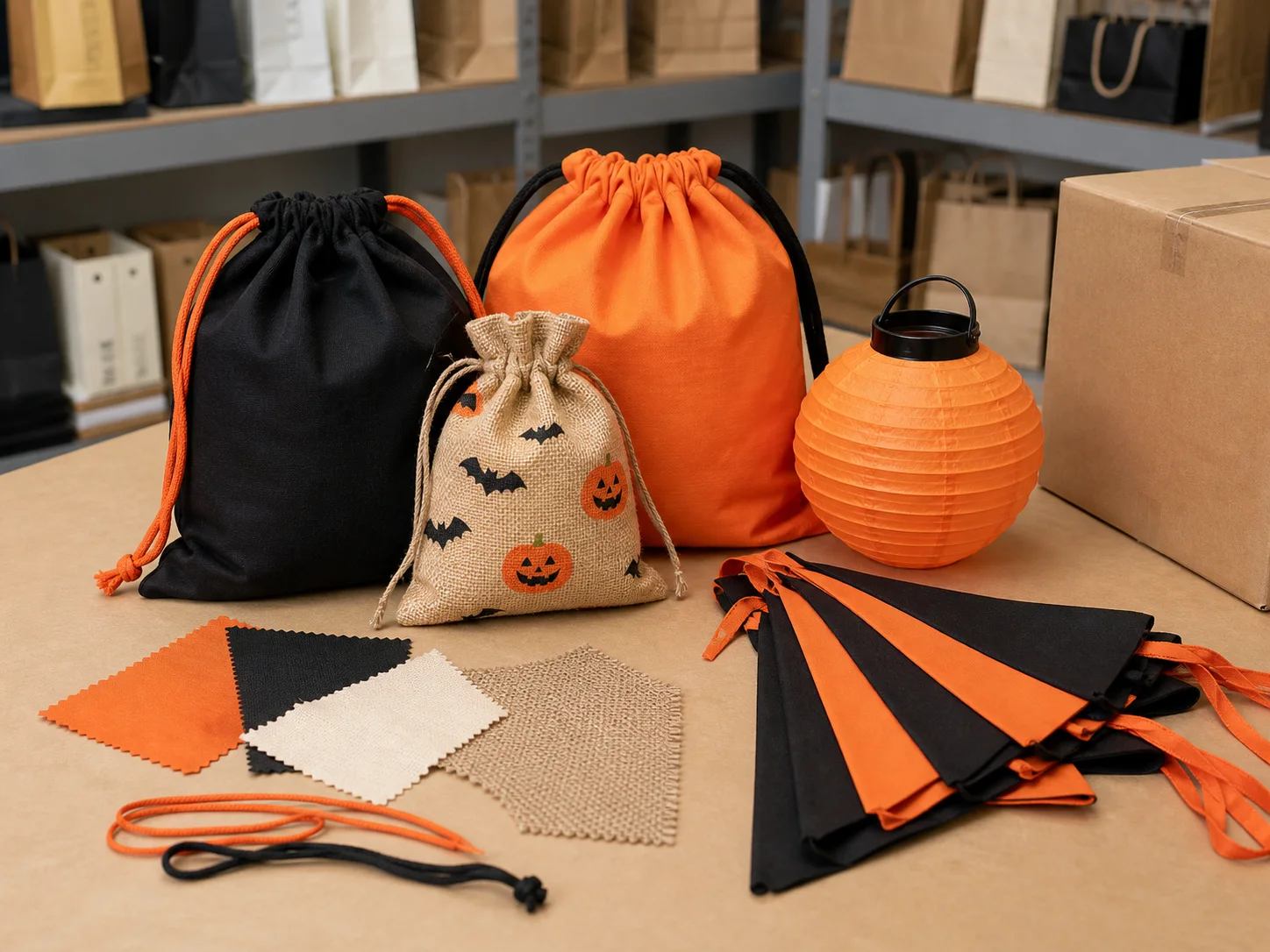
Halloween: prioritize executable products over late complexity
By late August, overseas Halloween buying becomes a timing exercise. New custom production followed by ocean freight may be unsuitable for some destinations and launch dates. Buyers filling inventory gaps should compare ready-stock products, limited customization, smaller priority shipments, or local finishing. Mode and route should be quoted case by case rather than assumed.
- Drawstring packaging: confirm finished size, usable capacity, fabric, cord, artwork position, color tolerance, packing quantity, and whether the pouch is sold as packaging or as a reusable product.
- Lanterns: define material, shape, print, hanging method, indoor or outdoor use, and whether lighting components are included. Never infer fire, weather, or electrical performance without relevant test evidence.
- Flags and banners: confirm dimensions, print visibility, finishing, pole or base system, wind exposure, and packaging length.
- Artificial flowers: provide color references and arrangement requirements; where a venue requests fire-performance evidence, define the required standard before production.
Christmas: lock the specification before multiplying SKUs
Christmas ranges often combine more colors, gift sizes, ribbons, surface decoration, display accessories, and retail packs. The main risk is not a lack of ideas; it is allowing too many variants to remain undecided while the shipping window narrows.

A practical Christmas program starts with a core specification and a controlled variant plan. Approve the base fabric, finished dimensions, cord, printing method, color references, unit packing, carton marks, inspection points, and destination requirements. Only then add colorways or size extensions. If launch timing is critical, discuss whether the order should be split by priority rather than treating every SKU identically.
EU packaging rules are now part of the sourcing brief
The EU Packaging and Packaging Waste Regulation generally applies from August 12, 2026. The European Commission states that it covers all packaging and packaging waste regardless of material or origin, with requirements concerning manufacturing, composition, reusability or recoverability, waste prevention, and the broader objective of economically viable recyclability by 2030.
A reusable fabric pouch can support a lower-waste proposition, but “reusable” is not an automatic compliance claim and does not by itself determine whether the item is legally packaging or a product. Importers and brands should document the intended function, materials, components, unit and transport packaging, destination market, responsible economic operator, labeling, and applicable national obligations. Legal and EPR responsibility should be reviewed for the actual selling model.
A six-point purchase check before placing an order
| Decision | What to confirm | Why it matters |
|---|---|---|
| Product role | Packaging, reusable product, décor, or component | Changes specifications and compliance scope |
| Artwork | Final file, color reference, location, and approval method | Prevents seasonal graphics from becoming unusable |
| Quantity | SKU split, trial quantity, reorder option | Reduces overstock and fragmented production |
| Quality | Measurements, stitching, print, count, packing checks | Turns subjective expectations into inspectable points |
| Delivery | Cargo-ready date, route, booking, destination buffer | Separates production timing from arrival timing |
| Documentation | Material data, test needs, packaging and importer records | Supports market access and buyer due diligence |
Commentary: seasonal sourcing is becoming less speculative
The strongest 2026 programs are likely to be those that make seasonal products easier to understand, reuse, replenish, and document. Decorative impact still matters, but excessive variety, uncertain delivery, and vague environmental language carry growing costs. The better sourcing question is no longer simply “What looks festive?” It is “What can be approved, delivered, sold, and supported with evidence?”
Planning Halloween replenishment or a Christmas range?
Send the product type, reference image, dimensions, quantity, logo or artwork, destination, and required arrival date. Tokicraft can review the specification and discuss sampling, ready-stock options, production, inspection, packing, and export coordination.
Request a sourcing reviewSources and publication note
- National Retail Federation: 2026 annual retail forecast and 2025 holiday benchmark
- National Retail Federation: Halloween data and survey release schedule
- Maersk: North America Market Update, July 2026
- European Commission: packaging waste and PPWR overview
Information checked on August 23, 2026. This article is market commentary, not legal, customs, logistics, or financial advice. Editorial images are AI-generated sourcing illustrations and are not evidence of specific production or shipments.